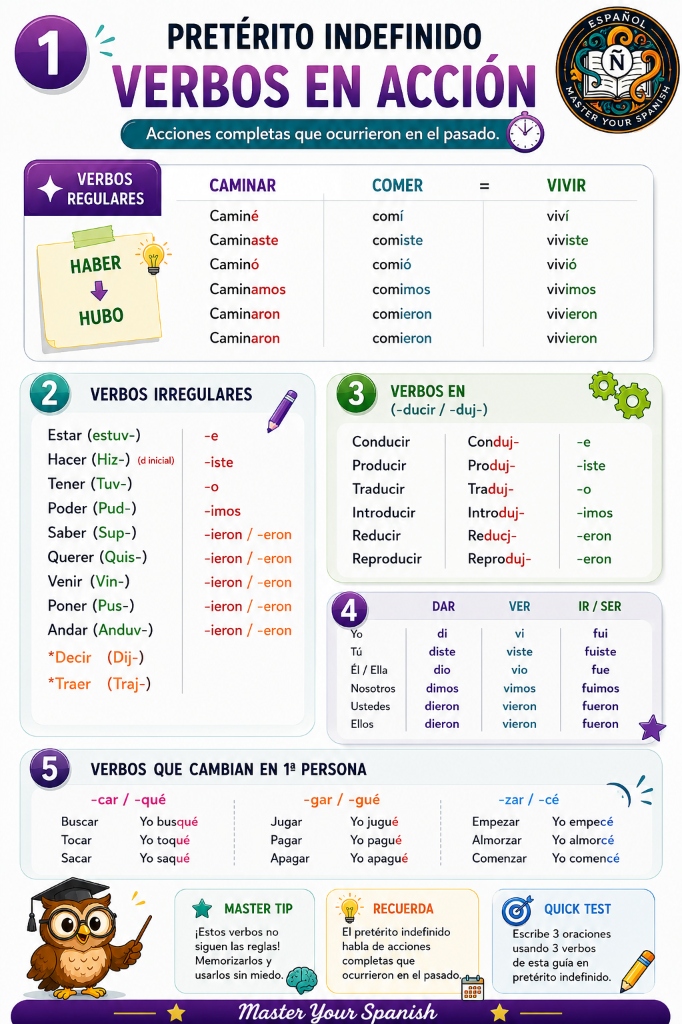
Pretérito Indefinido (Simple Past)
Master the 8 conjugation groups of the Spanish simple past tense: regulars, strong stems, spelling changes, and interactive quizzes without vosotros.
Los 8 Grupos del Pretérito Indefinido
El Pretérito Indefinido describe acciones terminadas en un momento específico del pasado con un principio y un final definidos. Explora cada grupo para dominar sus reglas y ejercicios prácticos sin 'vosotros'.
-e, -iste, -o, -imos, -ieron/-eron.
Verbos Regulares & Haber
Terminaciones regulares -é/-í y -ó/-ió con tildes obligatorias en 1.ª y 3.ª persona, y el uso impersonal de 'hubo'.
Raíz Fuerte (Sin Tildes)
11 verbos esenciales con raíz modificada y terminaciones comunes (-e, -iste, -o, -imos, -ieron): estar, tener, hacer, poder, poner, saber, venir, querer, andar, caber, haber.
Verbos en -ducir & Raíz en -J
Conducir, producir, traducir, traer y decir: su raíz en -J absorbe la 'i' en la 3.ª persona plural (-eron, no -ieron).
Gemelos & Breves: Ser/Ir, Dar y Ver
Ser e Ir son 100% idénticos en el pasado (fui, fue). Dar y Ver son gemelos monosílabos breves sin tildes (di, dio, vi, vio).
Ortográficos en 1.ª Persona ('Yo')
Cambios fonéticos exclusivos en 'Yo' ante la terminación -é: -car (-qué), -gar (-gué) y -zar (-cé). ¡Las demás personas son 100% regulares!
Cambio Vocálico en 3.ª Persona (-IR)
La 'regla del zapato' para verbos -IR: E→I (pedir, sentir, servir) y O→U (dormir, morir) cambian únicamente en él/ella y ustedes/ellos.
Cambio Fonético I → Y en 3.ª Persona
Entre dos vocales, la 'i' se convierte en 'y' (leyó, creyeron, oyó, cayó, construyó). Tildes de hiato obligatorias en las demás personas.
Marcadores Temporales & Consejos Clave
Palabras clave pasadas (ayer, anoche, el año pasado, hace dos días) y reglas mnemotécnicas esenciales del Búho Maestro 🦉.
🏆 Reto Maestro: 20 Preguntas de Pretérito Indefinido
Pon a prueba tu dominio combinando verbos regulares, raíces fuertes, cambios ortográficos y de 3.ª persona sin 'vosotros'.